
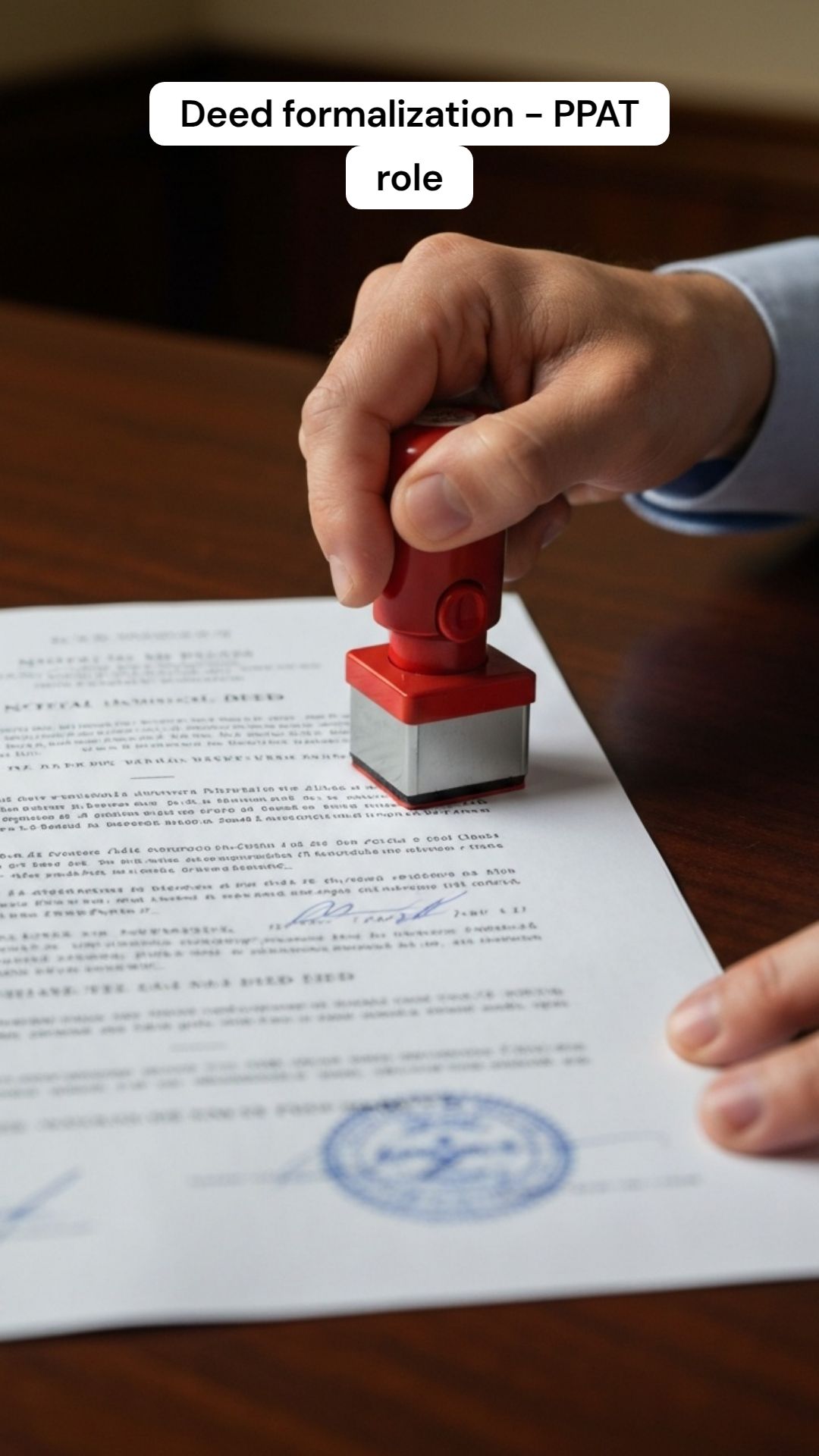
What Does a PPAT Notary Do in Bali Property Transactions?
A PPAT notary drafts and executes all land deed transfers in Bali. Learn what a PPAT does, when you need one, and how to choose the right one.

Quick answer: what a PPAT does in a Bali property deal (2026)
- A PPAT deed (AJB) is the only document that transfers land title in Bali. A PPJB or private sale agreement is not enough; it binds the parties but moves nothing at BPN.
- Fee cap: 1% of value up to Rp 500 million, sliding down to 0.25% above Rp 2.5 billion (Permen ATR/BPN 33/2021), witnesses included.
- BPN registration: 2 to 8 weeks after the AJB is signed and taxes are paid; the whole transaction typically 8 to 10 weeks from deposit to new certificate.
- The PPAT is neutral. They act for the transaction, not for the buyer. You still need your own lawyer for due diligence and negotiation.
WhatsApp +62 877-9626-0478: book a licensed Bali PPAT
PPAT fee cap and buyer taxes
| Transaction value | Maximum PPAT fee (Permen ATR/BPN 33/2021) |
|---|---|
| Up to Rp 500 million | 1% |
| Rp 500 million to Rp 1 billion | 0.75% |
| Rp 1 billion to Rp 2.5 billion | 0.5% |
| Above Rp 2.5 billion | 0.25% |
| Buyer taxes on top | BPHTB 5% (buyer), PPh Final 2.5% (seller), materai Rp 10,000 per deed |
Typical PPAT-handled transaction timeline
The stage-by-stage timeline table is at the top of this page. In practice, the BPN registration window (2 to 8 weeks) is where most of the variance sits, driven by the land office workload and whether the certificate needs correction first.
A PPAT (Pejabat Pembuat Akta Tanah) is a notary specifically licensed by the Indonesian Ministry of Agrarian Affairs to draft and authenticate land-related deeds. In every Bali property transaction – whether freehold, HGB, Hak Pakai, or leasehold – a PPAT is the legally required public official who drafts the Sale and Purchase Deed (AJB) or the Lease Deed (Akta Sewa), verifies the certificate at BPN, calculates and collects the transfer taxes, and registers the new title in the buyer’s name. Without a PPAT deed, the transfer is not legally recognised in Indonesia.
This guide explains exactly what a Bali PPAT does, how they differ from a regular notaris, how to choose one, and what the PPAT process looks like from reservation to certificate collection.
Notaris vs PPAT – the difference
For company deeds, powers of attorney, wills and prenuptial agreements you need a Notaris, not a PPAT: see our notary vs PPAT fee caps guide. This page covers land deeds only.
In Indonesia, two similar but distinct public officials handle legal documents:
- Notaris (notary): licensed under the Notary Law, authorised to draft a wide range of authentic deeds – company incorporations, wills, powers of attorney, loan agreements, share transfers, leases under 10 years, and marital property agreements.
- PPAT (land deed official): licensed separately under the Agrarian Law, authorised specifically to draft and register the deeds that transfer or encumber land rights – AJB (sale and purchase), Akta Sewa (lease), Akta Hibah (gift), Akta Tukar Menukar (exchange), Akta APHT (mortgage), Akta Pembagian Hak Bersama (division of co-owned rights), and several others.
In practice, most senior lawyers in Bali hold both commissions – they are Notaris & PPAT – and can handle both the corporate and land sides of a transaction in one office. Our firm’s principals are fully licensed as Notaris and PPAT.
What a PPAT does in a property transaction
1. Verifies the land certificate at BPN
The PPAT obtains a certified copy of the current land certificate from the issuing BPN office and cross-checks it against the seller’s original. This confirms the certificate is authentic (forgeries exist), matches the official land book (buku tanah), and has no registered encumbrances – liens, caveats, court orders, or matrimonial disputes. This step alone has saved countless foreign buyers from buying land that was not the seller’s to sell.
2. Confirms zoning and planning compliance
A PPAT will review the property’s zoning classification under the relevant Regional Spatial Plan (RTRW). In Bali, zones are colour-coded – red for commercial, yellow for residential/mixed, green for agriculture or conservation. A “beautiful piece of land” in a green zone cannot legally host a villa and is worthless to most foreign buyers, regardless of title type.
3. Drafts the deed
The PPAT drafts the deed in Indonesian (required by law) and – when either party is a foreigner – a bilingual Indonesian/English version. The AJB for a sale must contain: exact particulars of the property (certificate number, surat ukur, land area), identities and capacities of the parties, transfer price, declarations about the property’s status, tax calculations, and signatures executed in the physical presence of the PPAT.
4. Collects and remits transfer taxes
The PPAT calculates and collects BPHTB (5% buyer’s transfer tax above the NPOPTKP threshold) and PPh Final (2.5% seller’s income tax on the transaction), issues the tax payment slips, and deposits the amounts with the tax office before the deed can be registered. The PPAT keeps the tax receipts as part of the closing file.
5. Registers the transfer at BPN
After signature and tax settlement, the PPAT submits the complete file – original certificate, AJB, tax receipts, identity documents, and application forms – to BPN. BPN records the transfer in the buku tanah and issues a new certificate in the buyer’s name. This stage takes 2-8 weeks depending on BPN workload.
6. Delivers the new certificate
The PPAT collects the new certificate from BPN and hands it to the buyer, often with a bound file containing the signed deeds, tax receipts, and BPN receipts. This binder is the buyer’s evidence of ownership and should be kept safely.
PPAT fees – how they are structured
PPAT fees in Indonesia are capped by regulation at a maximum of 1% of the transaction value, though most PPATs charge less for larger transactions (typically 0.5% – 1%). Fees are normally split equally between buyer and seller unless the parties agree otherwise.
Separate from the PPAT fee, buyers also pay: BPHTB (5%), BPN registration fees (regulated, modest), and any title-search or certification fees. Sellers pay: PPh Final (2.5%). A PPAT will give a clear itemised cost estimate before the deed is drafted.
What a PPAT cannot do
- Bypass the law. A PPAT who agrees to draft a nominee deed, record a fictitious price, or ignore a BPN block is committing a criminal offence. Good PPATs refuse – it protects them and it protects you.
- Represent one party’s interests alone. The PPAT is a neutral public official. Foreign buyers should also have their own lawyer advising them – particularly on contract negotiation, due diligence scope, and cross-border tax planning.
- Guarantee zoning changes or permit approvals. Those are separate administrative processes.
How to choose a Bali PPAT
- Confirm the licence. Every PPAT has a specific territorial jurisdiction, usually a regency (kabupaten) or city (kota). A Denpasar PPAT cannot draft a deed for land in Gianyar. The PPAT for your deal must be licensed in the regency where the land sits.
- Ask about foreign-client experience. Bilingual deeds, KITAS-linked Hak Pakai, PT PMA share transfers, and cross-border tax planning all require experience beyond standard Indonesian conveyancing.
- Check for conflicts. A PPAT who is closely tied to a specific developer or agent may not be able to act neutrally.
- Get a fixed-fee quote in writing. Reputable PPATs give clear itemised costs including taxes, registration, and professional fees.
Timeline of a typical PPAT-handled Bali transaction
| Stage | Timing |
|---|---|
| Reservation agreement + holding deposit | Day 0 |
| Due diligence (certificate check, zoning, liens) | Day 1-14 |
| Draft deed circulated | Day 14-21 |
| Deed signing + tax settlement | Day 21-28 |
| BPN registration | Day 28-56 |
| New certificate delivered | Day 56-70 |
PPAT services beyond sales and leases
A PPAT handles many transactions foreign clients eventually need beyond the initial purchase:
- Mortgage registration (APHT): the formal deed granting a bank a security interest in the land.
- Partition (Akta Pembagian Hak Bersama): splitting a co-owned title, e.g., dividing inherited family land among heirs.
- Gift deeds (Akta Hibah): transferring property to a relative during the owner’s lifetime.
- Exchange (Akta Tukar Menukar): swapping plots between owners without a cash sale.
- Release of mortgage (Roya): removing a paid-off mortgage from the BPN record.
- Extensions and renewals of Hak Pakai/HGB.
Red flags – when to walk away from a PPAT
- Pressure to sign without seeing the certificate or BPN check.
- Reluctance to issue an itemised cost estimate.
- Refusal to draft the deed bilingually.
- Suggesting under-declared prices to reduce tax.
- Working with a single agent or developer and resisting your own lawyer’s involvement.
- No physical office in the regency where the land sits.
Frequently Asked Questions
Does the PPAT represent me as the buyer?
No – the PPAT is a neutral public official, not your advocate. Hire your own lawyer to negotiate and advise.
Can a PPAT handle the transaction if I’m not in Bali?
Yes, with a notarised power of attorney executed in your country, legalised or apostilled, and filed with the PPAT. Our firm handles remote closings routinely.
Can the same PPAT act for both buyer and seller?
Yes, and this is the norm. The neutrality of the PPAT is what makes it acceptable.
How is the PPAT fee paid?
Typically at signing, from the escrow balance collected on the transaction, split evenly between parties unless otherwise agreed.
Is a private purchase agreement (PPJB) enough?
No. A PPJB is a preliminary contract – it creates a personal right between parties but does not transfer title. Only the AJB (signed before a PPAT and registered at BPN) transfers legal ownership.
Work with a licensed Bali PPAT
Our principals at The Bali Lawyer are licensed as both Notaris and PPAT, with offices in Kerobokan, Bali and in Jakarta’s ASG Tower. We handle foreign property acquisitions, leasehold structuring, HGB registrations, PT PMA formations, and everything in between, end-to-end, in Indonesian and English. Book a free consultation to discuss your transaction.
Watch: Notary & Property explained
Short legal explainer videos from licensed Indonesian lawyers, updated for 2026.